
Synthetic Data Is Strongest When Edge Cases Stay Visible
Synthetic data has many uses, but it can sometimes make an AI project look more accurate than it really is. A model may perform well on generated examples that resemble average behavior, then stumble when it meets a rare input, a messy environment, or a combination nobody simulated. The issue is not the synthetic data itself. The issue is the assumption that synthetic data will be able to cover all the cases that the AI might encounter when it runs on real datasets.
Synthetic data is artificially created information that mirrors the statistical patterns of real data without copying real records. A 2024 review of synthetic data generation methods describes its value for privacy, data scarcity, and training AI systems across varied data types. A related explainer on synthetic data generation platforms notes that these tools can support training, validation, and stress testing, but only when the generated data preserves meaningful complexity.
Edge Cases Need Real-World Thinking
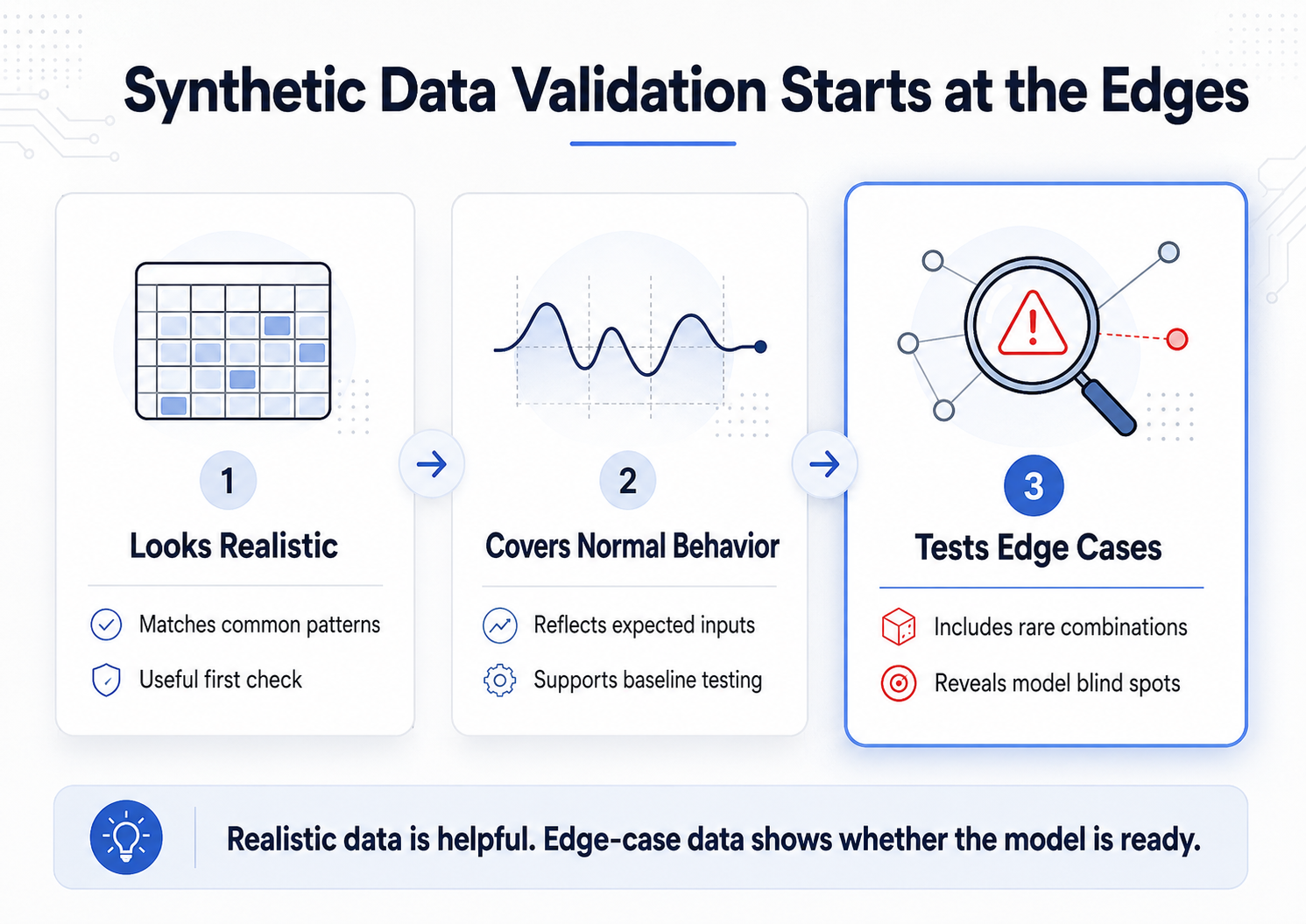
Good synthetic data work begins by acknowledging that the real world will likely contain cases that your training set didn’t account for. These could be extreme moments, ones that the average person would never account for in day-to-day life – the sort of moments you might see in a film or on a TV documentary about the extraordinary. Take, for example, something like bomb disposal: it’s not the kind of thing you’d expect to show up in everyday test data because it’s just not that common! But we still have to account for it when we model useful AI systems, so we’ve got to figure out how to incorporate it when training new software.
This profile of Kim Hughes bomb disposal expert is a useful and real example because it centers on variation, discipline, and situational reading in a very extreme setting. His explosive ordnance disposal background involved detection, identification, and neutralization, yet the harder part lies in understanding each device and environment without assuming any similarities between cases. That is exactly the mindset AI teams need when evaluating synthetic data.
Fidelity, Utility, Privacy, and Edge-case coverage are all important aspects here. Fidelity asks whether generated examples preserve real patterns. Utility asks whether models improve on real tasks after using those examples. Privacy asks whether the generated data avoids exposing sensitive source material. Edge-case coverage asks something sharper: what has the model never been forced to face? Kim Hughes, as a bomb disposal expert, makes the point clear without turning it into theory. Expert judgment is not about guessing. It is about respecting variation, checking assumptions, and staying careful when a situation looks familiar enough to tempt shortcuts.
What Edge Cases Reveal About Synthetic Data
| Validation angle | What it asks | Why it matters |
| Fidelity | Does the artificial data preserve important relationships from real data? | A dataset can look realistic while missing the interactions that influence model behavior. |
| Utility | Does it improve performance on real or carefully held-out tests? | Synthetic data should support the real task, not merely look convincing in isolation. |
| Coverage | Does it include rare, awkward, or overlapping conditions? | Many model failures appear where multiple unusual factors meet at once. |
| Human review | Would a domain-aware reviewer believe the scenario is plausible? | Generated edge cases can be dramatic without being useful unless they reflect real constraints. |
The table shows why synthetic data quality cannot be reduced to visual realism or statistical similarity. A generated image may look sharp. A synthetic table may preserve broad distributions. A text sample may sound natural. None of that proves the model has been tested against the situations that matter most.
The Simulation Gap Is Usually Subtle
The phrase “simulation-to-reality gap” often sounds like a robotics problem, but it appears anywhere synthetic data is used. Customer records may miss unusual sequences. Security logs may underrepresent coordinated behavior. Medical or operational datasets may contain rare combinations that are hard to create responsibly. A synthetic generator can smooth these awkward edges if the team does not deliberately preserve them.
This is where average performance becomes misleading. A model can score well because the test set rewards familiar cases. It may still be brittle when inputs are incomplete, noisy, contradictory, or drawn from a subgroup that was barely represented. Synthetic data can help by oversampling these conditions, but only when the team knows which uncomfortable questions to ask.
Stronger Models Come From Sharper Exceptions
The best use of synthetic data is not to replace reality. It is to widen the space where models can be challenged before they reach real users. That means combining generated examples with real-world checks, domain review, and evaluation methods that look beyond headline accuracy.
For builders and AI tool evaluators, the practical lesson is simple: synthetic data is strongest when it reveals uncertainty, rather than hiding it. Edge cases make datasets less tidy, but they make validation more honest. They help teams see whether a model has learned the task or only learned the cleanest version of the task.
A mature synthetic data strategy treats rare cases as first-class test material. That is where edge cases turn synthetic data from a convenience into a more serious engineering test for modern AI systems before release. It asks how examples were generated, what assumptions shaped them, which groups or conditions remain thin, and how the model behaves when familiar cues disappear. The goal is not endless caution. The goal is dependable learning. As a broad open-access survey of synthetic data generation, evaluation methods, and GANs explains, evaluation is central to understanding whether generated data is useful beyond its surface resemblance.
